
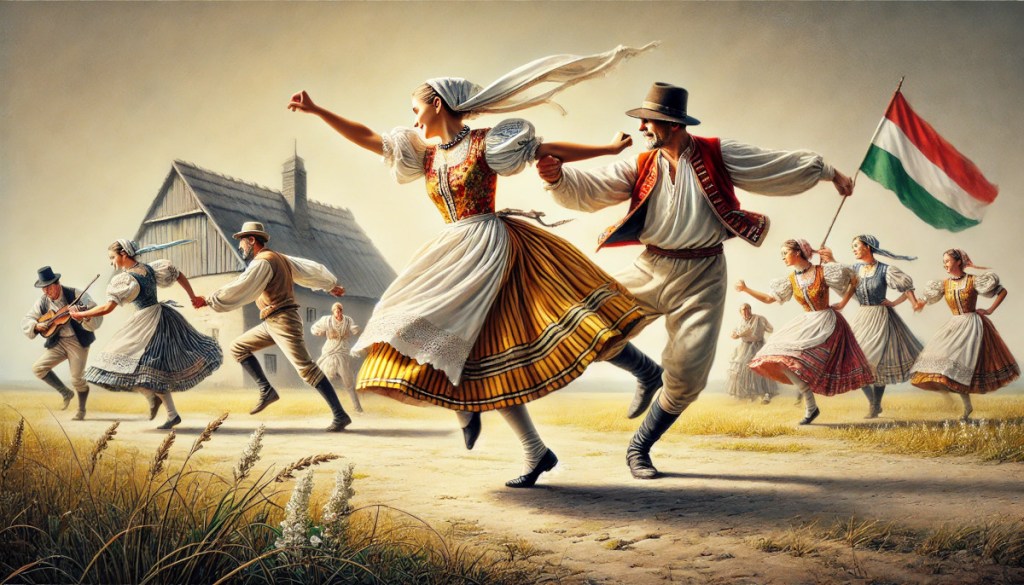
Zoltán Kodály collaborated with Béla Bartók to promote Magyar folk music. His work “Dances of Galánta” celebrates folk traditions, particularly verbunkos style, which contrasts slow and lyrical sections with lively rhythms. This orchestral piece intricately mixes distinct dance themes, showcasing virtuosic instrumentation and cultural pride.
Ethnomusicology
Zoltán Kodály (1882-1967) was a Hungarian composer. He studied at the Royal Academy of Music in Budapest. Theree he met Béla Bartók (1881-1945), the two became lifelong friends and champions of each other’s music.
As ethnomusicologists, they visited remote villages to collect and research old Magyar folk melodies, recording them on phonograph cylinders. They used to incorporate elements of such Magyar peasant music into their compositions, quoting folk song melodies verbatim and even writing pieces derived entirely from authentic songs.
Folk dances of Galánta region
Kodály was comissioned a work to celebrate the 80th anniversary of the Budapest Philharmonic Society. He found a collection of folk music published around 1800, which documented the popular dances of the Galánta region, a village where he spent part of his childhood. The composer taken his principal themes from these old publications, most of the themer were in verbunkos style.
In “Dances of Galánta” (1933) Kodály didn’t simply quote these folk melodies verbatim. He used them as a foundation and developed them into a more complex orchestral form. The verbunkos melodies are central, especially in their alternation between lyrical slow sections and rapid, lively ones.
The traditional Verbunkos style
This style was originally associated with military recruitment ceremonies. Soldiers or recruiters performed these lively dances to attract young men into the army, using music to show skill, vitality, and national pride.
The most defining feature of Verbunkos is the contrast between slow section, lyrical and almost improvisational, and fast ones, highly rhythmic and full of virtuosic flourishes.
Verbunkos featured the use of instruments such as the clarinet, violin, cimbalom (a hammered dulcimer), and the tárogató (a type of single-reed instrument). These instruments brought a unique timbre to the music and were central to Hungarian folk and military bands.
Dances of Galánta
Zoltán Kodály’s Dances of Galánta is structured as a rhapsodic single-movement orchestral work. Within it, Kodály introduces several distinct sections, each based on different folk themes.
The piece begins with a slow introduction, lyrical and nostalgic. The clarinet solo marks the transition to next sections: the dance themes.
Five distinct dance sections follow, with alternating slow and fast tempos, featuring instrumental solos (especially the wind section) and developing orchestration. The final section evokes the brilliant skill of Gypsy violinists, with its bright colors and the pronounced virtuosity of all the orchestral sections. A clarinet cadenza and a recap of the main themes heard earlier bring the composition to a close.

 Classical Wonders