
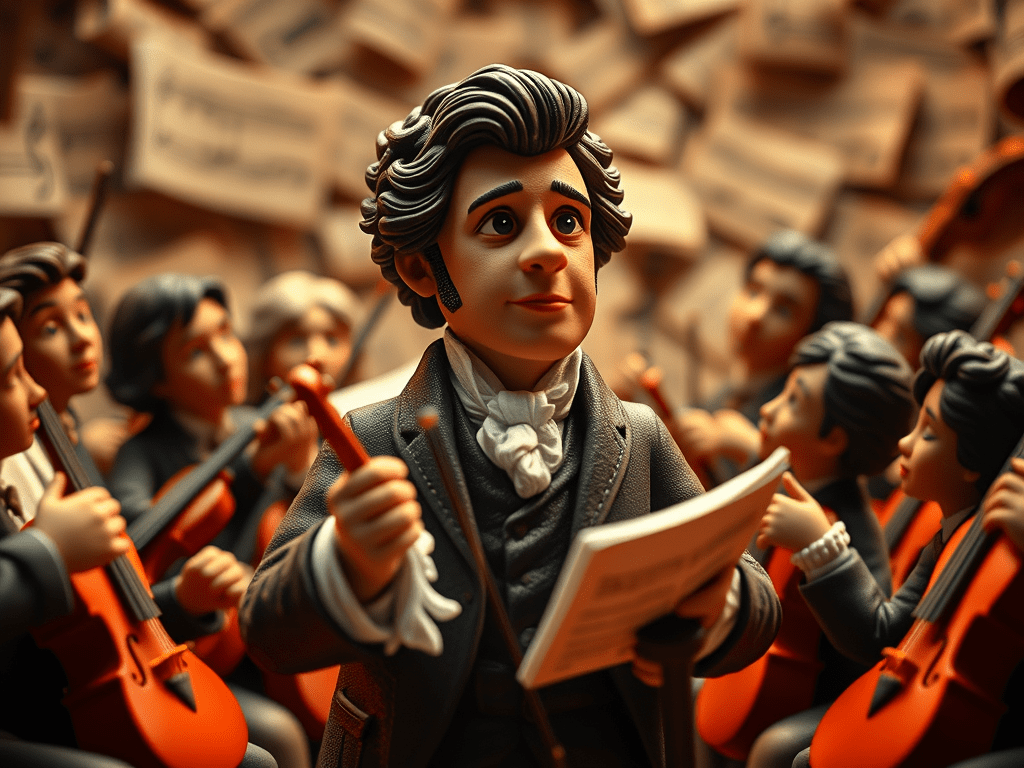
Louis Spohr wrote a very unusual symphony, the 6th. While the first three movements are a tribute to the Baroque and Classical period, the fourth is a satirical parody of the “modern” composers.
The background
The german composer Louis Spohr (1784-1859) was highly regarded during his lifetime, although he his almost forgotten nowadays.
He was a very popular and highly valued composer, having written a large number of concertos, operas, quartets, and symphonies.
Between Classical and Romantic
His music spans the transition between Classical and Romantic music.
To him the historical progress of music had reached perfection with the classical period of Haydn, Mozart and early Beethoven.
At the same time, he felt that his contemporary composers (the “latest of the new”, as he called them) were a step too far.
This point of view made him compose in 1839 a peculiar work, the Symphony No. 6. The “Historical Symphony” is composed in four movements.
The first three movements are written in Baroque and Classical style, the fourth is a parody of “The Very Latest Period”.
The 6th symphony
Spohr opens with a Baroque-inspired movement, imitating the style typical of composers like Bach and Handel. This section evokes the grandeur and complexity of Baroque contrapuntal orchestration.
The second movement shifts to the Classical period, with the grace, balance, and elegant style of Haydn and Mozart.
In the next section, Spohr emulates Beethoven’s dramatic and emotionally intense approach, with more daring harmonies and robust orchestration.
In the finale ‘The Very Latest Period’, Auber and Meyerbeer and others are treated satirically. With a not too veiled reference to French operas and ballets, the music is on purpose filled with contradictions and contrasts of metre, tempo and style.
Orchestration
The differences between the movements are accentuated by differences in orchestration with a gradual growth in size. “Bach-Handel” is scored for the usual strings plus two each of flutes, oboes, horns and bassoons; “Haydn-Mozart” adds two clarinets; “Beethoven” adds three timpani; and the finale expands to a full-blown romantic orchestra with the inclusion of piccolo, two more horns, two trumpets, three trombones, triangle, cymbals, bass drum and side drum.
Reception
At the first performance, the audience was confused and irritated by this finale, a weak parody of some of the operatic characters of the day. Is wasn’t clear whether Spohr wrote a tribute to earlier styles, or composing their techniques in his own manner. As a result, the baroque movement seemed a not very brilliant exercise in the manner of a Bach fugue and a Handel aria, the classical movement was more like Spohr but based on thin Mozart, while the scherzo had absolutely none of Beethoven’s dynamic charge, even in parody.
Critiques
Schumann summarized his personal (negative) reception, writing the following words about the first movements:
“These forms to which he is not accustomed bring out his individuality even more strongly, just as one with a particularly characteristic bearing reveals himself most clearly when he assumes a disguise … when this symphony was played one could hear from every comer of the hall the sound ‘Spohr’ and again ‘Spohr’“.
Mendelssohn didn’t appreciate the finale, at the point he suggested that:
“A finale in the style of Spohr’s own operatic overtures would have been better“, “a greater instrumental piece in freer form, somewhat like the overture to Faust or so many of your magnificent, spirited overtures in its place”.
Shumann wrote again, this time about the finale:
“‘the Newest or Latest of the New’ was a complete failure. Such noises might be produced by Auber, Meyerbeer and the like, but Spohr should not lend his pen to writing such stuff’”.

 Classical Wonders