
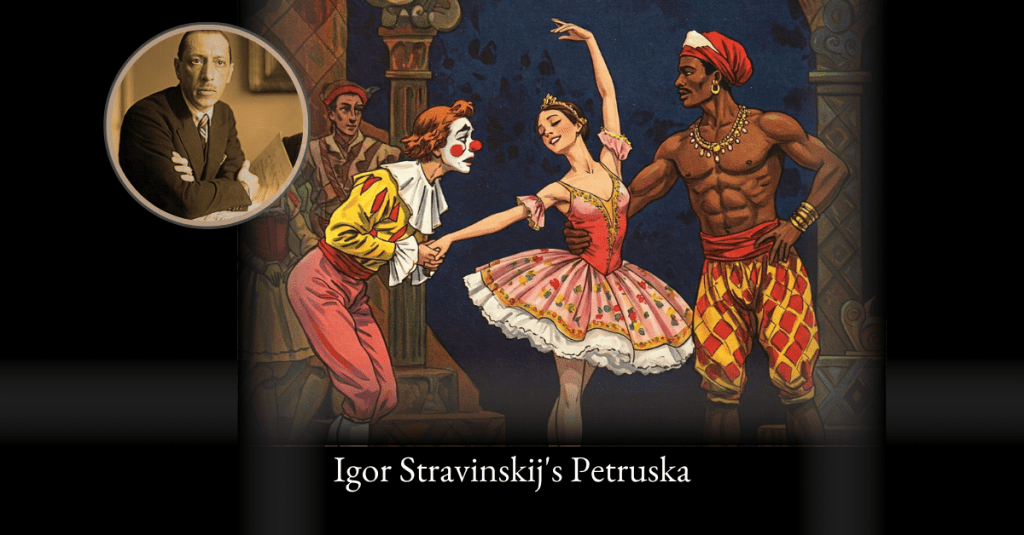
Igor Stravinskij’s Petruska is a masterpiece that everyone should hear at least once. The first five minutes are an exceptional example of Stravinsky’s absolute genius.
The idea behind
In 1910, Igor Stravinsky (1882-1971) wanted to take a break during the composition of The Rite of Spring. He thought of a piece for orchestra in which the piano had a predominant role. He imagined it being performed while an unruly puppet tussled with the orchestra in a constant exchange of blows. This gave rise to the idea of calling it Petrushka, after the popular Russian puppet.
Diaghilev, founder of the Ballets Russes, listened to the roughly sketched piece and immediately wanted to work with Stravinsky to turn it into a new ballet. The work was presented in 1911 in Paris and was positively received by critics from the very beginning.
Here is a description of the very first minutes of the opera, in its original 1911 choreography by Fokine.
Background
We are in Saint Petersburg, at Admiralty Square, during the Shrovetide week in 1830; a festivity that precedes the fasting period of Lent. The people are celebrating: the streets are crowded with passersby, street dancers, gypsies, law enforcement, onlookers, gossips, and coachmen. The fast and changing rhythm of the music emphasizes the comings and goings of the crowd.
The opening
The music starts with the flute playing a rhythmic theme:
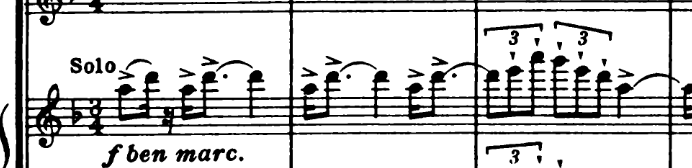
The flute is soon chased by the piano and the other instruments, preparing the scene for the next theme, with a developing crescendo.
As a group of drunken revelers emerges from the crowd, a Stravinsky’s adaptation of the Russian folk-tune “Song of the Volochobniki” is played as a grand fanfare at full orchestra:

Then, with roll of timpani, a brass and a sudden tonality change, the Master of Ceremonies makes his appearance on the balcony of his booth, boasting the attractions to be seen inside.

The two dancers
In the meantime, a firts Dancing Girl emerges from the crowd, accompanied by a organ-grinder (clarinets and flutes playing another Russian folk-song, “Toward Evening, in Rainy Autumn”).

At first the crowd pays little attention to the dancer, and the barker continues to shout. Then, the dancer moves downstage and begins to dance to another song, a ribald French music-hall song about a woman with a wooden leg: “Une Jambe de bois”.

While the song is repeated by flutes, clarinets and trumpet, a second Dancing Girl appears on the scene, accompanied by a music box (the celesta in the orchestra). The two Dancing Girls compete for the crowd’s attention for some time, until it is interrupted by the return of the drunken revelers.
The chaos of the fair
From this point on, the themes heard so far are presented again, in a tight sequence as if chasing each other. On the stage, the fairground is now buzzing with noise, laughter, and cheers. The resulting crescendo culminates in a full orchestral passage, suddenly interrupted by a roll of two drums. This announces the entrance of The Magician, or “Charlatan” as he is sometimes called, and his three puppet: the Dancer, the Moor and, of course, Petrushka.
The first five minutes
This is the beginning of the true story of Petrushka, of his love for the Ballerina hindered by the Moor. Only five minutes have passed since the start of the opera, the main characters have not yet entered the scene, and yet we have already heard an exceptional amount of high-quality music.

 Classical Wonders