
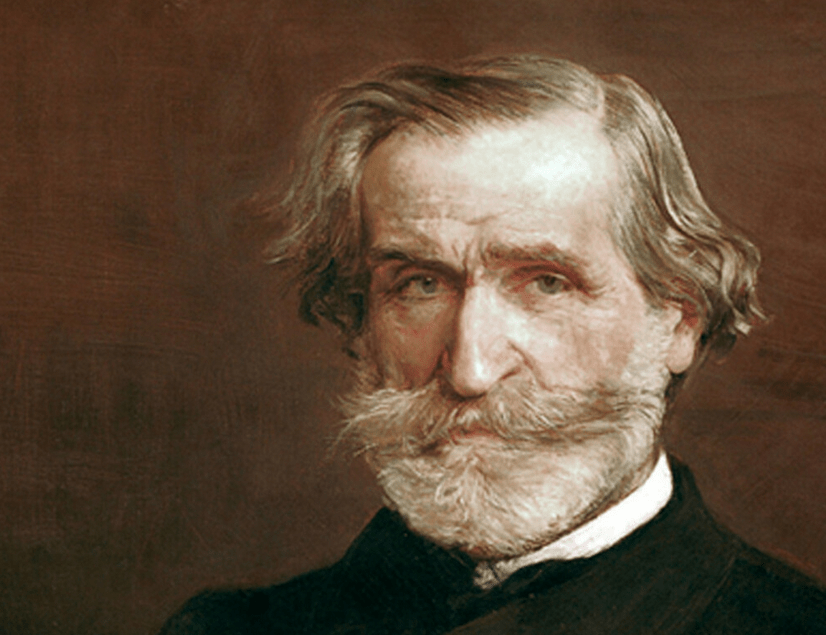
It was 1873 when an excited Giuseppe Verdi (1813-1901) wrote to his editor a letter telling him that he “would like to put in music a Mass for the dead [Requiem], to be performed next year for the first anniversary of his [Manzoni’s] death. This Mass would have great extent, with a big orchestra and a choir, and it would need four or five singers too”.
Inscribed to Alessandro Manzoni
In 1873 Alessandro Manzoni died. He was an Italian poet, novelist and philosopher. He wrote The Betrothed (orig. Italian: I promessi sposi), symbol of the Italian politic movements of those years. Verdi shared with Manzoni the values of justice and freedom, characteristics of Italian political movement “Risorgimento” that led, a few decades later in1861, to the consolidation of the Kingdom of Italy.
This is what moved Verdi in putting the inscription of his new Requiem to Manzoni.
Giuseppe Verdi
He was the Opera itself. At least for Italian opera of middle ‘800. He wrote a total of 27 operas, maybe you already heard about Aida, Rigoletto, Nabucco.
During his life he changed his composition style, and adapted it to the new techniques used by other contemporary composers. While in the first period of his life he followed Rossini’s legacy, made of essential elements like the aria, the duet, the ensemble, and the finale sequence of an act.
Toward the late period of his composing life, Verdi changed to a very different way of making operas. He followed the new popular tastes, coming from Wagner ideas (the leitmotiv, the elaborate orchestration, and the decline of the use of closed forms like arias) and the French opera (a wide use of different rhythms, orchestral textures, melodic motifs).
Dies Irae
The Requiem belongs to Verdi’s late period. It includes a dense orchestration, and the use of a big orchestra especially in the number of brass (trumpet, trombones, etc) involved.
The structure comes from the traditional Requiem mass, but, differently from it, Verdi assigned several parts to one soloist, and also included duets and quartets.
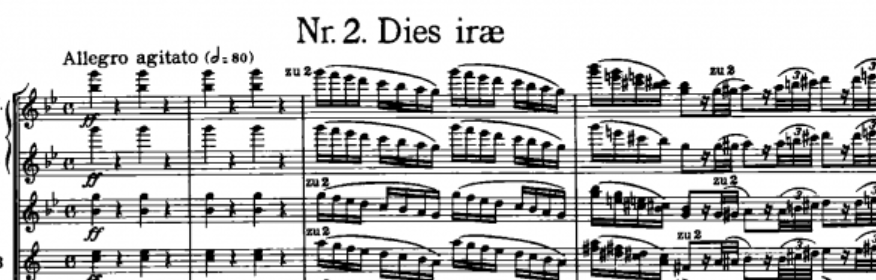
Memorable is the Dies Irae. It starts with powerful chords that alternate with bass-drum blows offbeat, while the orchestra performs a rising phrase and a falling response. What a very terrifying and recognizable piece of music!

 Classical Wonders