
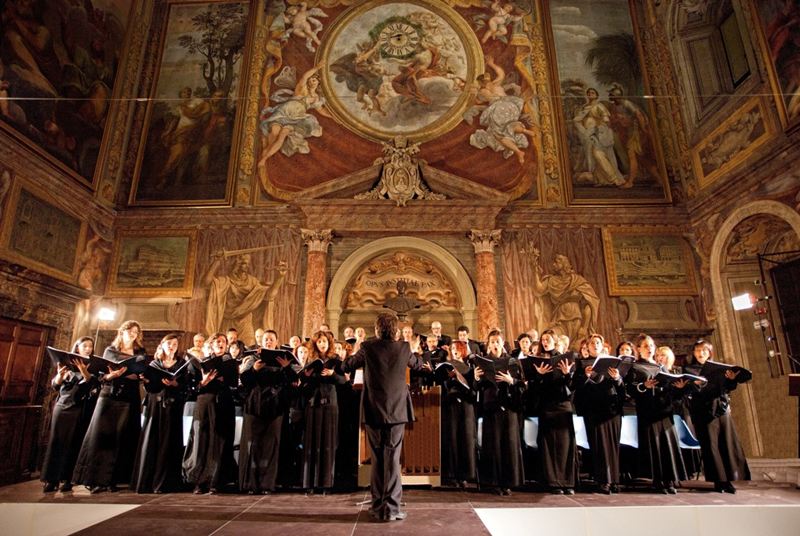
Sergei Rachmaninoff (1873-1943) wrote Liturgy of St. John Chrysostom in 1910, after returning from a tour in America.
The inspiration
For a long time, Rachmaninoff had been thinking about writing a large-scale sacred composition. After returning from a long concert tour in the United States, Rachmaninoff seemed to find the quiet environment of Ivanovka favorable to composition.
The composition of the “Liturgy” completely absorbed the composer for a few weeks in summer 1910. Rachmaninoff wrote in a letter to his friend Nikita Morozov: “I have just finished composing a liturgy (to your great astonishment, I imagine). I had been thinking about it for a long time. I began almost by chance; I quickly became passionate about it and soon finished the work with great satisfaction…”
A sacred composition
Rachmaninoff was not a particularly devout Orthodox believer, his visits to church were quite rare. The motivation to compose a liturgy came from the idea, widely circulated at the time in Russian musical circles, that ancient sacred polyphony was a Slavic heritage. However, the sentiment that inspired the composer, rather than being directed towards an abstract religiosity, reflects the spirituality of the Russian people. A very earthly spirituality, firmly rooted in ancient traditions.
The music Form
The Divine Liturgy of Saint John Chrysostom is a Eucharistic celebration of the Byzantine Rite, it is the equivalent to the Mass of the Latin Rite. Rachmaninoff work is composed by 20 separate pieces, a division that does not correspond to the real needs of the liturgical celebration. As a result, some pieces are considered as standalone, and form an inseparable part of the liturgy and are therefore performed without interruption.
Unaccompanied choir
The score is written for a mixed four-part choir. The choir is unaccompanied, making the work a pure vocal piece. Of all the movements, three contain solo passages, for alto, bass and soprano. Two are scored for an eight-part double choir. Rachmaninoff makes full use of the choir’s expressive potential. Even tough the vocal parts make a sophisticated use of counterpoint and polyphony, they remain incredibly fluid and natural.
Reception
After the Moscow premiere, Russian Orthodox ecclesiastics strongly objected the work’s modernism and refused to use it during church services. Rachmaninoff did nothing to promote the work himself, and it soon fell into obscurity.
In the last years the Liturgy has gained renewed interest among choirs specializing in Orthodox liturgical music, particularly outside Russia. Choral groups in Europe, North America, and Asia have added the work to their repertoires, often in tandem with Rachmaninoff’s more famous All-Night Vigil (Vespers, Op. 37). Performances of the Liturgy tend to be rare, but its complexity and spiritual depth attract choirs interested in exploring lesser-known sacred works.

 Classical Wonders