
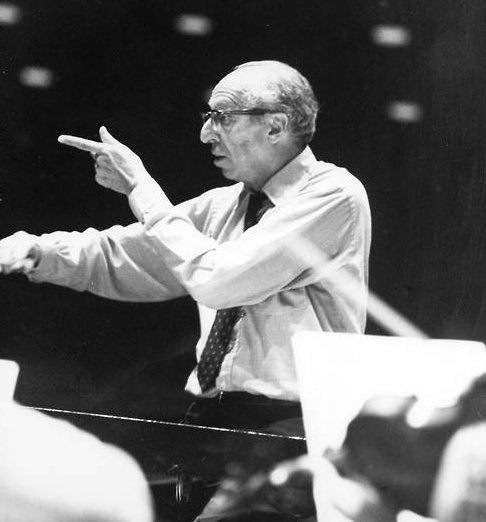
Connotations for orchestra (1962) has been a turning point in Aaron Copland’s (1900-1990) career. Career that took a hard hit the evening of the premiere.
The score is in twelve-tone style, rhythmically disjunctive, for a full orchestra with augmented percussion and piano.
At the time, the audience was not ready for such a revolutionary Copland.
A concert for a new opening
Bernstein was in charge of organization for the opening concert to be held in september 1962 to celebrate the New York Philharmonic’s new home in the Lincoln Center. The evening was to be attended by 2600 guests, many of them prominent figures of contemporary America. Just as example, JF Kennedy was in the list too.
Starring
Leonard Bernstein invited ten of the more internationally known composers to contribute to the opening with their music. Among them: Samuel Barber, William Schuman, Darius Milhaud. And Copland too. This had a meaning for Copland, his position was unique among “serious” American composers and testified him as a creative figure with a close relationship with the American public.
Copland at work
Copland worked day and night for about a year, even cancelling work tours in that period not to waste time. His effort was to present something not bland or traditional for such an occasion and distinguished audience. He decided to offer “a contemporary note,” one that would reflect the tensions, aspirations and drama inherent in the world today.
Connotation for orchestra
The result is 20 minute long performance, and it is written in twelve-tone serial style. The row is played by trumpets and trombones at the beginning, then a series of variations alternate fast and slow sections, composing a ABCBA form. The use of massive chords, dissonances and a constant sense of tension make the piece challenging to grasp.
The premiere
The reception was a disaster.
The evening of the premiere, people considered the sound of the new concert hall more important than the music. It would be a perfect opportunity for more traditional music. Copland himself admitted that “the premiere was not a congenial circumstance” and the modernity of the composition “was not appreciated at the time.”
The first reaction was of near-silence and incomprehension. People were expecting another Appalachian Spring, but had a atonal work, difficult to understand at one hearing. Some of them hated the piece, other complained that a revolutionary Copland seemed to confront the gala Lincoln Center audience. The same audience the traditional Copland had won through years of hard effort during his populist period.
The background: Copland’s Populist period
Aaron Copland gained his celebrity during the “populist period”, in the 1930s and 40s, when he wrote his most famous works. The list includes El Salón México, Billy the Kid, Appalachian Spring, among others. These works use an accessible music style, with a jazz-influenced use of melodies, some of them folk tunes. A general American atmosphere and an extended use of transparent and bare harmonizations made this works to be unanimously received.
Late works
In the late works of 1940s and 1950s, Copland included the use of twelve-tone system. He didn’t strictly adhere to serialism, but used some of the principles to enlarge his musical angle of vision. His approach to dodecaphony was a personal and selective adaptation of serial techniques rather than strict adherence to Schoenberg’s principles. His music remained accessible and captivating, even now that as he explored more modern and experimental compositional methods.
Connotations, ten years later
Pierre Boulez succeeded Bernstein as music director of the New York Philharmonic in 1971. He was in his element with this kind of music, and presented Connotations again in the Hall for the ten-year anniversary of Philharmonic Hall. According to Copland, a decade had provided sufficient time for audience perceptions to improve. This time the reception was good, and the piece entered among Copland works that continued to be programmed by orchestras.

 Classical Wonders