
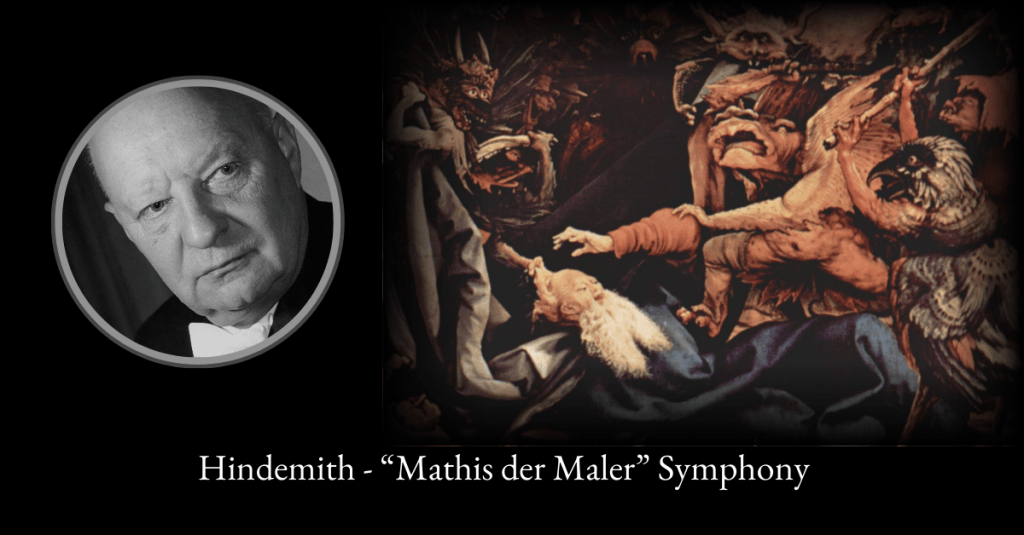
Hindemith’s Mathis der Maler: A Bold Symphony in Tough Times
The Backstory
In the early 1930s, Paul Hindemith (1895-1963) was one of the most important among the “new generation” of composers in Germany. But the rise of the Nazi regime changed everything. His modern musical style, his ideas, and even his personal life didn’t fit the new rules. His music wasn’t banned right away, but it was under a heavy pressure.
At the time, Hindemith was working on an opera called Mathis der Maler (Matthias the Painter), based on the life of Matthias Grünewald, a Renaissance painter known for his emotional and spiritual Isenheim altarpiece. The story of the opera was about an artist struggling between creating his art and getting involved in the political chaos of his time – basically, Hindemith’s own situation.
But the opera couldn’t be staged. Too controversial. So Hindemith had a clever idea: turn parts of the opera into a symphony. It was a way to share his music without triggering full censorship. “Mathis der Maler” Symphony was written and premiered in 1934, while the opera itself wasn’t premiered until 1938 in Switzerland, outside Germany.
The structure
The symphony has three movements. Each one is inspired by a scene from Grünewald’s Altarpiece.
- Angels’ Concert (Engelkonzert). This part feels sacred and calm. You hear soft harmonies and a peaceful mood, like a quiet church filled with music.
- Entombment (Grablegung). This movement is much darker. It speaks of death and sorrow, with slow, heavy sounds. There’s real emotional weight here.
- The Temptation of St. Anthony (Versuchung des heiligen Antonius). This is the most intense. It starts chaotic, with clashing sounds, like someone fighting off nightmares. But by the end, there’s clarity and peace – a kind of spiritual victory.
The music
The Symphony, as Giacomo Manzoni points out, marks a really important turning point in Hindemith’s music. It opens the door to a new style for Hindemith. He starts looking for smoother melodies, less sharp rhythms, and softer harmonies. In short, his music becomes more “classical” in feel. Later on, this shift would even lead to a more academic or formal style in some of his work.
The idea of turning an opera into a symphony was unusual back then. It was both a creative and political move. Hindemith used the orchestra like a voice, telling a story without words. That was brave and smart.
How People Reacted
When the symphony premiered in March 1934, it was conducted by Wilhelm Furtwängler—one of the top conductors in Germany. The audience loved it. Big applause, great reviews.
But the Nazi regime didn’t change its mind. Even after the successful premiere, Hindemith’s music was soon banned. He left Germany a few years later.
Still, the Mathis der Maler Symphony became one of his most performed works. Today, it’s seen not just as a musical masterpiece, but also as a symbol of artistic resistance. Hindemith used music to speak up—when words were too dangerous.

 Classical Wonders