
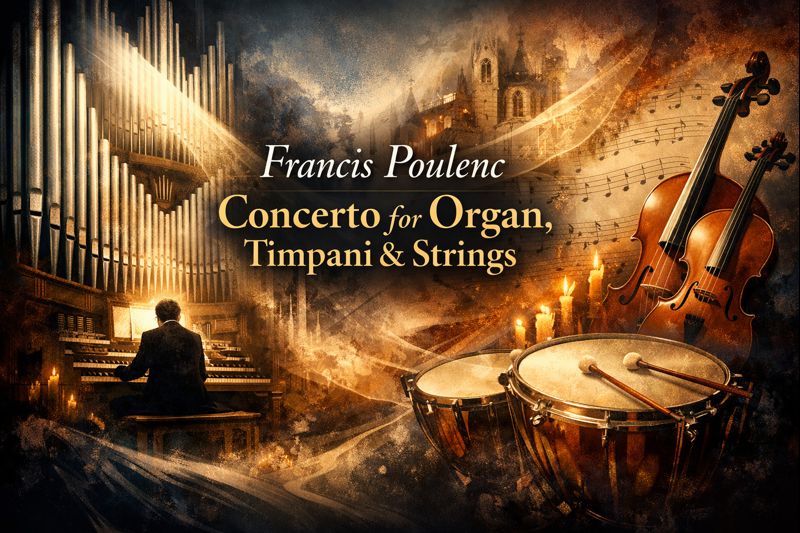
Concerto for organ, timpani and strings by Francis Poulenc is not a typical baroque-sounding piece, even though it might sound like it at first. It’s actually a game-changer from the 20th century.
Some context
It was written in 1938. Poulenc (1899-1963) was a French composer, part of that quirky crew Les Six – modern, ironic, anti-Romantic. He usually wrote playful pieces, but for this piece he was on a totally different mood.
Winnaretta Singer
In 1934 Winnaretta Singer asked Poulenc for a light and elegant piece for organ, to be played (by her, too, an amateur player) in her private salon.
Winnaretta had a interesting story:
- she was an American-born heiress to the Singer fortune (yes, from the Singer sewing machine family!)
- she was the 20th of the 24 children of Isaac Singer
- her mother, for some times, was considered the model for the Statue of Liberty, though this claim was later rated false
- she openly enjoyed many relationships with women. After a first failed marriage, she married an older, gay amateur composer. This second unconsummated marriage had been happy – full of mutual respect and friendship.
- established a salon in Paris in the music room of their mansion on Avenue Henri-Martin. The Polignac salon came to be known as a haven for avant-garde music. Some first performances of Chabrier, d’Indy, Debussy, Fauré, and Ravel took place there.
Ideas can change
The idea of a simple piece for organ was abandoned in favor of a majestic and richly complex score. In fact, Poulenc took four years to complete it, and despite working on other compositions, he was fully committed to creating something truly remarkable.
At that time, Poulenc was going through a personal transformation. The sudden loss of a close friend in a car crash deeply shook him. Searching for meaning, he turned to religion and even made a pilgrimage to Rocamadour. This change had a strong impact on his work, especially on the still unfinished Concerto for Organ.
The Concerto
So instead of a nice little salon piece, he went and wrote this massive, intense, spiritual concerto.
The structure is unusual: a single movement, lasting about 20 minutes, with alternating slow and fast tempo marks.
The opening sections are loud and quite violent, with substantial organ chords, while the following sections are much calmer and softer.
As instrumentation, the Concerto was meant to be performed in a small space, since small halls equipped with an organ were quite common in France at the time, so the need was for a small ensamble.
Poulenc’s Concerto for Organ blends old and new: you can hear echoes of Bach, that suddenly become 20th century harmonies and rhythm twists.




 Classical Wonders