
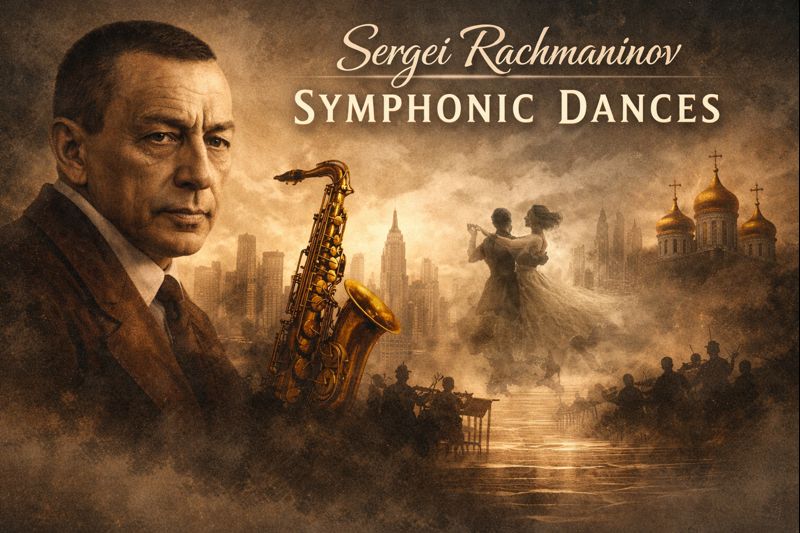
Sergei Rachmaninov (1873-1943) wrote Symphonic Dances in 1940, at the very end of his life. It is his final major composition, and his only piece written in its entirety while living in the United States.
Origin of the work
In America he was famous, rich, and busy as a pianist. The exile from Russia, which he left after the 1917 Revolution, never stopped hurting, leaving him in a state of physical decline and profound existential reflection. He missed his language, his culture, and even the sound of Russian orchestras.
Symphonic Dances came after four years of silence after his previous piece, the 3rd symphony. At that time, something unlocked inside him. He knew the musical world was changing fast, and he knew his own style was seen as “old-fashioned.” Instead of fighting that, he embraced it and turned it into something powerful.
The structure
The work is a bridge between the lush Late-Romanticism of his youth, and the leaner, more percussive “Neoclassicism” of the mid-20th century.
The Symphonic Dances is structured in three movements.
- The first movement is tense and sharp. The rhythms are strong, sometimes aggressive. The harmonies are darker than his earlier works. Right away you hear something new: a solo for alto saxophone. That was unusual in classical music at the time, especially for a composer like him. It gives the music a strange, modern color.
- The second movement is a ghostly waltz. It sounds elegant at first, but something feels off. The beat limps, the mood is uneasy. It’s like a dance seen through a distorted mirror.
- The final movement is the most dramatic. Rachmaninov brings back his favorite idea, the medieval Dies Irae chant, which he used many times before. But here it fights with another theme: a bright, almost religious melody from the Russian Orthodox tradition, “Hallelujah” from his All-Night Vigil. At the end, light wins over darkness. He even wrote “Hallelujah” in the score.
Orchestration and dedication
Rachmaninoff wrote an arrangement for two pianos concurrently with the orchestral version. The piano version was completed in August 1940 and the orchestral version in October of the same year. When he orchestrated it, he worked very closely with the Philadelphia Orchestra, which he loved deeply.
It was premiered by Eugene Ormandy and the Philadelphia Orchestra, to whom it is dedicated, on 3rd January of 1941. It was a success. But Rachmaninov didn’t live long enough to see how important it would become in the future.
Behind the Scenes
The original name of the piece was Fantastic Dances, with movement titles of “Noon”, “Twilight”, and “Midnight”. In the end he dropped the titles, but the idea of a day moving toward night still fits the music well.
The Failed Ballet: Rachmaninov originally envisioned the work as a ballet. He even met with the legendary choreographer Michel Fokine to discuss a collaboration. Sadly, Fokine died before the project could materialize, leaving the music to live on solely in the concert hall.
Rachmaninov introduced the alto saxophone into the first movement. This was a radical choice for a traditional symphonist, used not for jazz influence, but to evoke a sense of ancient, lonely Russian plains.

 Classical Wonders