
If someone asked me to tell what “classical music” is, I would pick a passage from the Balakirev’s 1st Symphony. The way the clarinet opens the third movement, Andante, is a perfect example of classical music. The melody is just an excuse, here, to create beauty and wonder.
Only eight measures
The third movement of the 1st Symphony (1897) from Milij Alekseevič Balakirev (1836-1910) is an Andante.
The clarinet solo is the first exposition of the main theme for the movement. It lasts only eight measures, but it is the foundational element for the following development and elaboration.
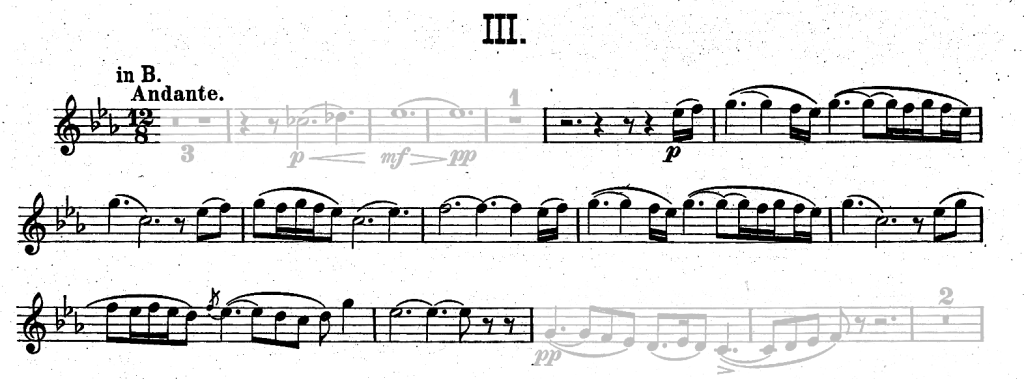
I actually use this solo as a lullaby for my children. Its mix of long notes and (softly) moving passages make it perfect to make them fall asleep.
A simple starting melody
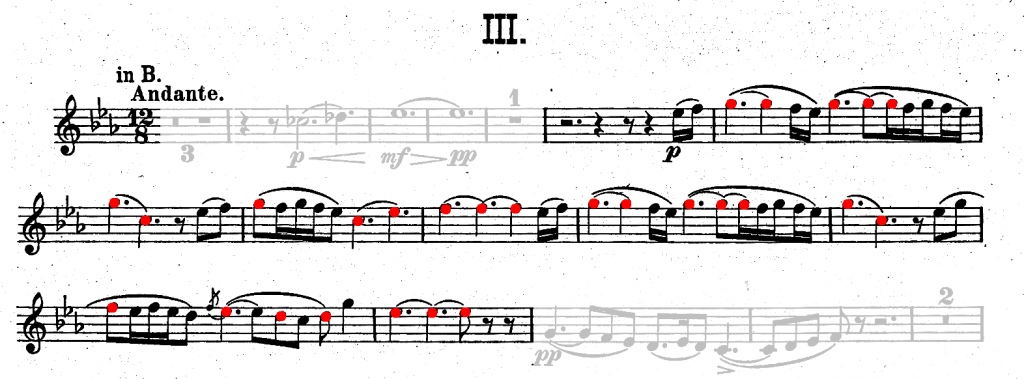
The base melody is very simple, see the red notes in the image below.
You can see that the main notes are restricted to a fifth, and there are only diatonic notes. The chords played by the orchestra are simple, too. Basically, there are first, fourth, and fifth grade chords with very few exceptions.
Add some spice
Some spice is added to the starting musical material. Balakirev adds lots of passage notes, in red in the image below. These notes add magic to the melody.
Here, a good player knows that playing these notes too hard would make the passages too fast to be tasted properly, they would be thrown away. On the contrary, these notes are to be played in tempo, but in a smooth way, very softly, too keep the melody as soft as a lullaby.
An example of magic
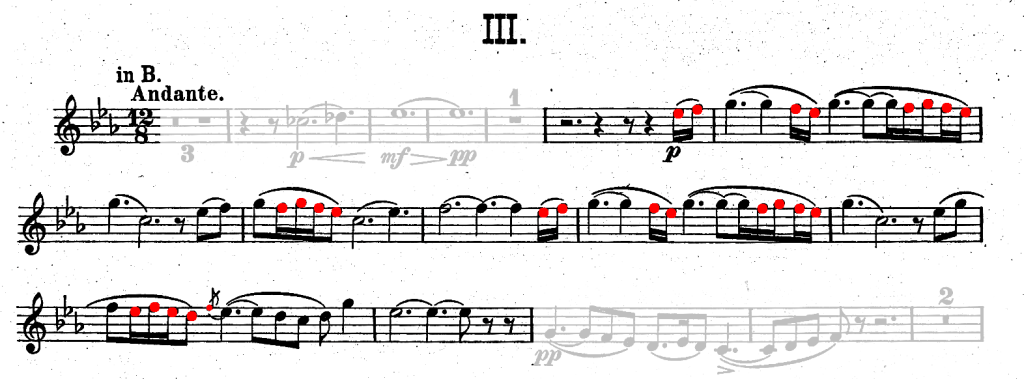
As an example of what “magic” means to me, see how the two red passage below differ.
The first time the note duration is smaller, giving a sense of dynamism to the opening of the solo, and that results in the following passage with quick notes. The second time the notes are slower (double duration), and this gives a sense of relaxation, welcomed after all that tension due to the “fast” notes.
And all this happens in three measures!

The role of the player
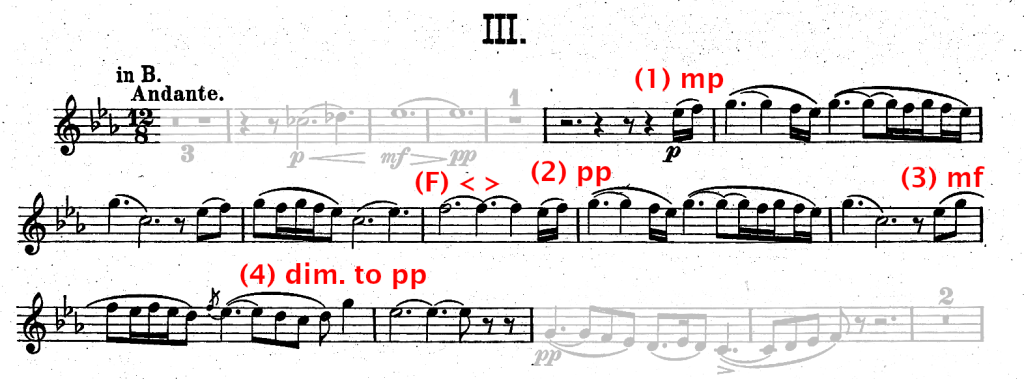
Balakirev writes only a generic p (piano) at the beginning of the solo. All the wonder, here, is left to the player.
The best recording I listened to is from BBS Philarmonic Orchestra (see Spotify link below).
I try to write below what you can hear.
Dynamics
The clarinetist opens (1) with a mezzo-piano, i.e. a piano but with more musical energy. The end, after four bars (F), is soft. The player keeps a F note for the whole measure. The note begins pianissimo and it gains strenght in the middle, just to vanish as the end approaches.
Then the theme is played again (2), this time pianissimo, barely audible. But it lasts only two measures, since at (3) the reprise is played vigorously, as to assert again the dynamism of the theme.
The end (4) go back to a pianissimo, and leaves the listener to a sonority more suited to the soft mood of the Andante movement.




 Classical Wonders