
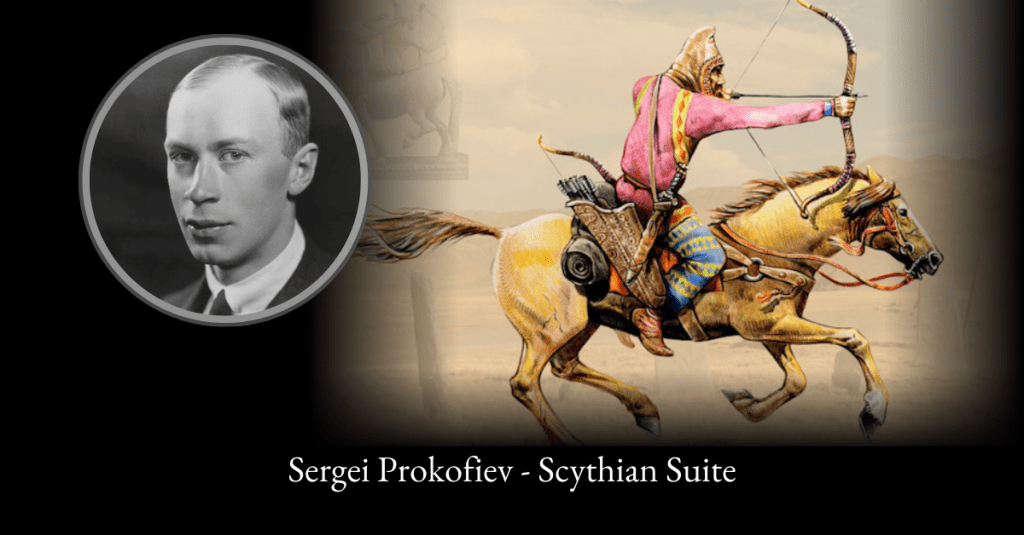
The Scythian Suite by Sergei Prokofiev is a wild, explosive orchestral work with a fascinating backstory.
A rejected Ballet and a bold new direction
In 1915, Sergei Prokofiev (1891-1953) was a young and ambitious composer looking for his big break. He got the chance of a lifetime when Sergei Diaghilev, the mastermind behind the legendary Ballets Russes, invited him to write a ballet. The theme whould be Ancient Scythian mythology, a world of nomadic warriors, pagan gods, and fierce rituals. Prokofiev dove into the project, crafting an explosive, primitive sound unlike anything heard before.
But there was a problem: Diaghilev hated it. He dismissed the music as too “noisy” and “barbaric,” saying it was impossible to choreograph. Instead of scrapping everything, Prokofiev salvaged the best parts and transformed them into a four-movement orchestral suite. And just like that, the Scythian Suite was born—a work that would cement his reputation as a daring modernist.
A sound like no other
The Scythian Suite is not your typical classical music. From the first notes, it hits you with massive orchestral forces—thundering drums, blazing brass, and jagged harmonies. It’s raw, aggressive, and thrilling, often compared to Stravinsky’s The Rite of Spring for its sheer energy. But where Stravinsky builds complexity, Prokofiev goes straight for the jugular.
The suite’s four movements paint a loose narrative inspired by Scythian mythology:
- “The Adoration of Veles and Ala” – A volcanic opening filled with ominous brass and pounding rhythms, evoking a mystical, pagan ritual.
- “The Enemy God and the Dance of the Spirits” – A fast, furious explosion of sound, as if ancient warriors were clashing in battle.
- “Night” – A brief, eerie respite, filled with haunting melodies that feel both mystical and menacing.
- “The Glorious Departure of Lolli” – A triumphant, high-energy finale that surges with heroism and tension.
There’s a plot twist: despite its intense and savage tone, Prokofiev didn’t really take the Scythian myth seriously. He reportedly described the music as more about creating a “barbaric” atmosphere than depicting a historical narrative. Think of it as a fantasy soundtrack for an ancient world that existed more in his imagination than in reality.
Shock and Controversy
When the Scythian Suite premiered in 1916, it caused a stir. Audiences were divided—some were thrilled by its savage energy, while others were horrified by its sheer loudness and intensity. Critics didn’t know what to make of it. But one thing was clear: Prokofiev had arrived as a force to be reckoned with.
Prokofiev later recycled some of the suite’s themes in his Piano Concerto No. 2 and other works, showing how much he believed in the power of these ideas. If you’re into orchestral music that feels like an action movie, the Scythian Suite is a must-listen!


 Classical Wonders