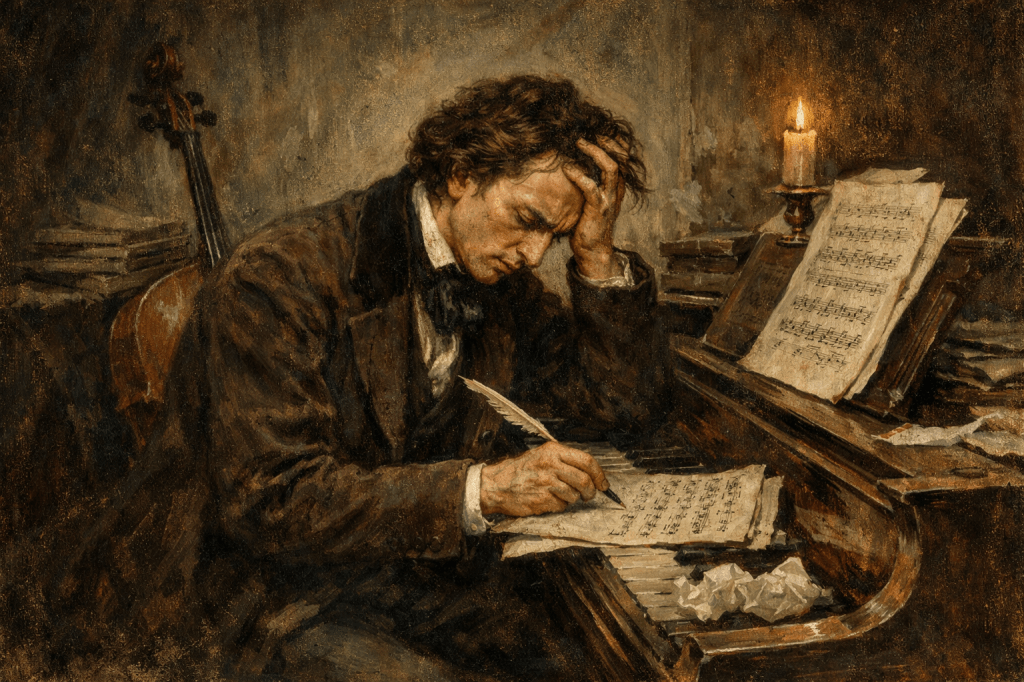
Chopin wrote his Sonata for cello and piano in 1845, dedicating it to his friend, cellist Auguste Franchomme. A unique work for Chopin: among the few chamber works of the composer, this is the only one that belongs to the mature period. During this time, Chopin reveals the most pioneering and experimental aspect of his music.
Structure
The piece is structured in four movements:
- Allegro Moderato: a determined theme in G minor contrasts with a second theme in G major that is more delicate and sweet. The dialogue between cello is intense: the piano part is dense, and the cello struggles to gain the right prominence. The harmonies are very complex, and foreshadow impressionistic sonorities.
- Scherzo – Allegro con brio: a rhythmic theme with numerous variations. Notably, the Trio, in which the cello part predominates distinctly over the piano part.
- Largo: in 27 measures Chopin creates an atmosphere similar to a Nocturne, with a nostalgic dialogue between piano and cello.
- Finale – Allegro: it returns to the vigor of the first movement, with complex and sometimes unpredictable passages. In the central part, a noteworthy counterpoint characterizes the development of the theme. The theme is taken from an incomplete Canon in F, which here returns in the form of a canon, alternated between the cello and the piano parts. The Coda concludes the piece in a positive and lavish atmosphere.
Curiosities
Chopin felt uncomfortable writing for an instrument other than the piano. This led him to set aside and later resume composition; it took him a total of two years to complete a version worthy (in his opinion) of being published.
The difficulties that Chopin had to face in writing a piece for an unfamiliar instrument can also be seen in another aspect. On several occasions, he accompanied the cellist Franchomme (to whom the work is dedicated) at his home, for a small audience of trusted friends. This allowed him to gather opinions before the publication of the piece. Something absolutely new for Chopin, who was not used to collecting others’ impressions before publishing a work.
For the first performance of the work, in Paris in 1848, the first movement Allegro Moderato was completely eliminated. This movement was deemed too complex and difficult, and hard to understand both by his friends and by experts. Only the Scherzo, the Largo, and the Finale were performed.
Reaction of the Critics
The Sonata for cello and piano is one of Chopin’s compositions that has never received the right consideration, not even today. Rarely performed in concert settings, from its first performance it was considered too innovative to be understood by the public and critics.