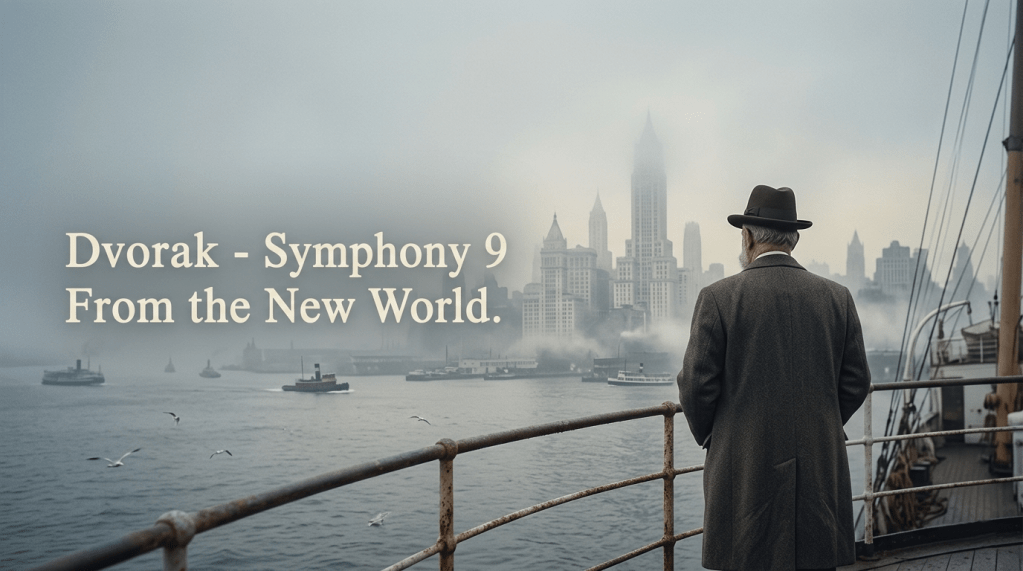
To leave comfortable life in Europe, hopping on a ship, and landing in the chaotic, booming streets of 1890s New York City. That is what Czech composer Antonín Dvořák did in 1892.
The call of the “New World”
Jeannette Thurber was a wealthy American arts patron. At that time America was still searching for its own musical voice, since European composers still dominated concert halls. Jeannette founded the National Conservatory of Music in New York, with the aim to develop a United States’s style of classical music.
Thurber offered Dvorak a massive salary to run the newly born National Conservatory of Music. About 25 times what he made in Prague, an offer simply too good to refuse.
The meeting with a unique musical culture, different from that of European masters, impacted his compositional ideas. The local culture inspired the musician to create a symphony that blended classical European and indigenous American music.
The influences of the new musical knowledge were indirect; in his symphony, the composer avoids quotations and instead uses his own sensitivity as a European musician to interpret the ideas from them.
The symphony was commissioned by the New York Philharmonic, and composed between December 1892 and May 1893, in New York. Not wanting his work to be identified as American Symphony, the title From the New World was attached by the composer at the last minute, just before sending the score to the conductor for rehearsals.
A technical look
The symphony follows the basic layout of a Romantic symphony.
- I. Adagio – Allegro molto: The movement follows the traditional sonata form. It starts with a quiet, tense introduction before exploding into a powerful, syncopated main theme. Here, the sense of space perfectly matches European ideas about America at the end of the nineteenth century: vast landscapes and open horizons
- II. Largo: This is the heart of the piece. It features a famous, deeply nostalgic melody played by the english horn
- III. Scherzo (Molto vivace): A fast, rhythmic dance inspired by the pounding beats of Native American rituals. Dvorak takes inspiration from scenes in The Song of Hiawatha, the epic poem by Henry Wadsworth Longfellow.
- IV. Allegro con fuoco: Pure fire. The brass section blasts an intense, marching theme. What makes this movement especially impressive is Dvořák’s use of thematic recall. A conclusion that feels both powerful and inevitable, bringing together everything that came before.
Orchestration
The symphony uses a large Romantic orchestra, including woodwinds, brass, percussion, and strings. Yet Dvořák avoids the heavy textures favored by some late-Romantic composers, and the orchestration remains remarkably clear.
The most famous example is the English horn solo in the Largo. Before this symphony, the instrument rarely occupied such a prominent role in orchestral music. Afterward, that sound became forever associated with the New World Symphony.
Composition techniques
In this composition, Dvořák moves away from his earlier symphonic style, adopting a more relaxed and creative approach, influenced by his new experiences in America. He noted the music he heard there and became interested in pentatonic scales, although he didn’t use the familiar motifs directly.
Dvorak wrote that “I have not actually used any of the [Native American] melodies. I have simply written original themes embodying the peculiarities of the Indian music, and, using these themes as subjects, have developed them with all the resources of modern rhythms, counterpoint, and orchestral colour.”
This Symphony stands apart
Many admired symphonies show great skill, but Dvořák’s Ninth does something special: it mixes technical skill with strong emotional impact. The melodies are memorable, and even those new to classical music often recall them after just one listen.
At the same time, the work offers great rewards for careful study. Under its simple exterior is a complex web of themes and well-crafted orchestral writing.
The symphony is special because it shows a moment of cultural exchange. A Czech composer, trained in Europe, met America when it was trying to find its artistic identity. The outcome was not fully European or American; it became something new.
Premiere and legacy
The Symphony premiered on 16 December 1893, at Carnegie Hall conducted by Anton Seidl. It was one of the biggest triumphs in music history. The crowd cheered so loudly after the second movement that Dvořák had to stand up and bow from his box seat like a rockstar.
Its popularity never faded, and its influence extended far beyond concert halls. The Largo theme entered popular culture through songs, films, television, and countless arrangements. During the Apollo 11 mission in 1969, astronaut Neil Armstrong reportedly brought a recording of the symphony with him to the Moon, a fitting journey for a work inspired by exploration and discovery.
Today, the New World Symphony remains one of the most frequently performed symphonies in the world. Audiences continue to respond to its combination of grandeur, warmth, and humanity.