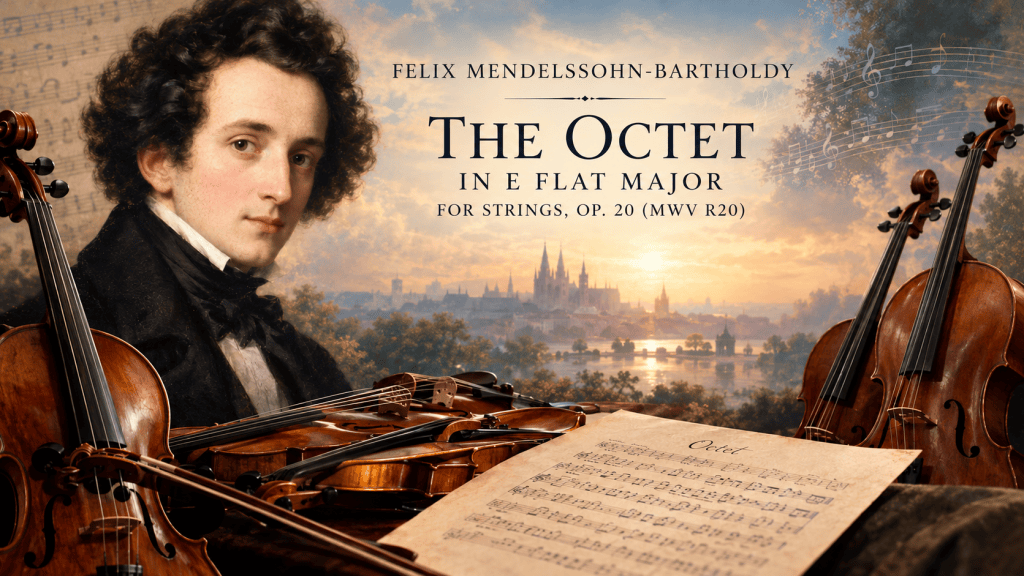
The String Octet in E-flat major, Op. 20 (MWV R20) by Felix Mendelssohn-Bartholdy is one of the most extraordinary examples of compositional precocity in the entire history of classical music.
This post is sponsored by cadenzavibes.com – explore our colorful products that enhance your classic soul with a contemporary twist.
The Birth of the Work
Mendelssohn composed the Octet in the autumn of 1825, when he was just 16 years old, as a birthday gift to Eduard Rietz. Rietz, his friend and violin teacher, was twenty-one at that time, and himself a virtuoso of the instrument.
Although so young, Mendelssohn demonstrated with this work that not only he had complete mastery of the compositional techniques of the period, but he went further: he introduced into the piece several innovative features for its time.
Orchestral Style
It is immediately apparent when listening that this string octet (4 violins, 2 violas, 2 cellos) is conceived in its overall texture. Differently from Louis Spohr, who two years earlier in his Double Quartet called for two string quartets set in opposition. Here Mendelssohn conceives the octet as an orchestral formation with eight independent parts.
He also intends the interpretation to be understood in an orchestral manner. In his own hand, in fact, he added this note beside the score:
“This Octet is to be played by all the instruments in the style of a symphony orchestra. The pianos and fortes must be carefully observed and emphasized with greater force than is customary in works of this kind.”
The orchestral and symphonic character of this work is so pronounced that the third movement (Scherzo. Allegro leggierissimo) was itself adapted by the composer into an orchestral version. From that moment on, this version took the place of the original Minuet in his First Symphony, written a year earlier when he was still fifteen.
Structure
The work is written for an ensemble of four violins, two violas, and two cellos and is divided into four movements, all composed in Sonata Form.
- Allegro moderato ma con fuoco
A broad, sunny, and exuberant movement, with the main theme entrusted to the first violin, which repeatedly sends the melody soaring upward - Andante
A melancholic, intimate, and introspective sound, characterized by chromatic counterpoint and a poignant atmosphere - Scherzo: Allegro leggierissimo
The music flows with an uninterrupted pianissimo, played with a “light staccato” bow stroke that creates a sense of weightless levity, the quintessence of Mendelssohn’s so-called “elvish” or “fairy-like” style - Presto
A breathtaking finale that opens with an eight-part fugue beginning in the cellos and gradually enveloping all eight instruments. Mendelssohn combines the rigorous art of counterpoint with irrepressible virtuosity
Reception and Curiosities
In the third movement (Scherzo), Mendelssohn recalls the melody “And he shall reign forever and ever” from the “Hallelujah Chorus” of Handel’s Messiah; this is a tribute to the composer and, more generally, to all Baroque music.
Mendelssohn’s sister Fanny revealed that, for the Scherzo, Felix had been directly inspired by the verses in the “Walpurgis Night Dream” section of Goethe’s Faust: “the flight of the clouds and the mist clear from above; the wind among the reeds and the whisper among the leaves, and everything vanishes.”
When Mendelssohn traveled to London in 1829 to conduct his First Symphony, he decided to replace the original Minuet with an orchestrated version of the Octet’s Scherzo, adding woodwinds to give it an even brighter color. The London audience appreciated the choice and immediately demanded an encore.
Despite the composer’s very young age, the work displays remarkable maturity. It is considered the first work of Mendelssohn’s full maturity, capable of surpassing in complexity and inventiveness much of the chamber music of the period.
The eminent musicologist Charles Rosen described Mendelssohn’s Octet as “one of the marvels of nineteenth-century music, characterized by a formal perfection that not even Mozart or Schubert had achieved at sixteen”.
For several years, the Allegro from this octet has been used as the time signal by the Italian state radio station “Rai Radio 3 Classica,” Italy’s leading broadcaster of symphonic music.